
Criminal Court Cases in Hamilton County
Hamilton County criminal cases divide by offense level. The 220th Judicial District Court hears felonies, and the District Clerk keeps those files. Hamilton County Court handles Class A and B misdemeanors plus appeals from Class C cases, with the County Clerk serving as custodian. Fine-only charges may remain with Hamilton County Justice Court, Hamilton Municipal Court, or Hico Municipal Court. Searching just one court can miss a valid file even when the name and date are correct.
The filed case record begins after a prosecutor accepts or changes a charge. It can include an information or indictment, counsel appearances, hearing notices, motions, plea papers, judgment, and sentence. An arrest report is held by the arresting agency, while a booking file is held by the jail. Readers tracing the event from custody to judgment can use the separate Hamilton County arrest search for that first stage.
Hamilton County Courts Split Case Files
The court split is the first local fact to resolve. Felony questions go to the District Clerk at 102 North Rice Street, Suite 215, Hamilton, Texas 76531, or 254-386-1240. Class A and B misdemeanor questions go to the County Clerk in Suite 107 at the same courthouse, by phone at 254-386-1203 or 254-386-1205. Justice Court numbers run from 254-386-1220 through 254-386-1224. Hamilton Municipal Court routes fine-only city cases through 254-386-1221, while Hico Municipal Court is at 120 West First and 254-796-4620.
The Hamilton County Clerk page shows the misdemeanor role and links current criminal dockets. Its official page is also captured below.
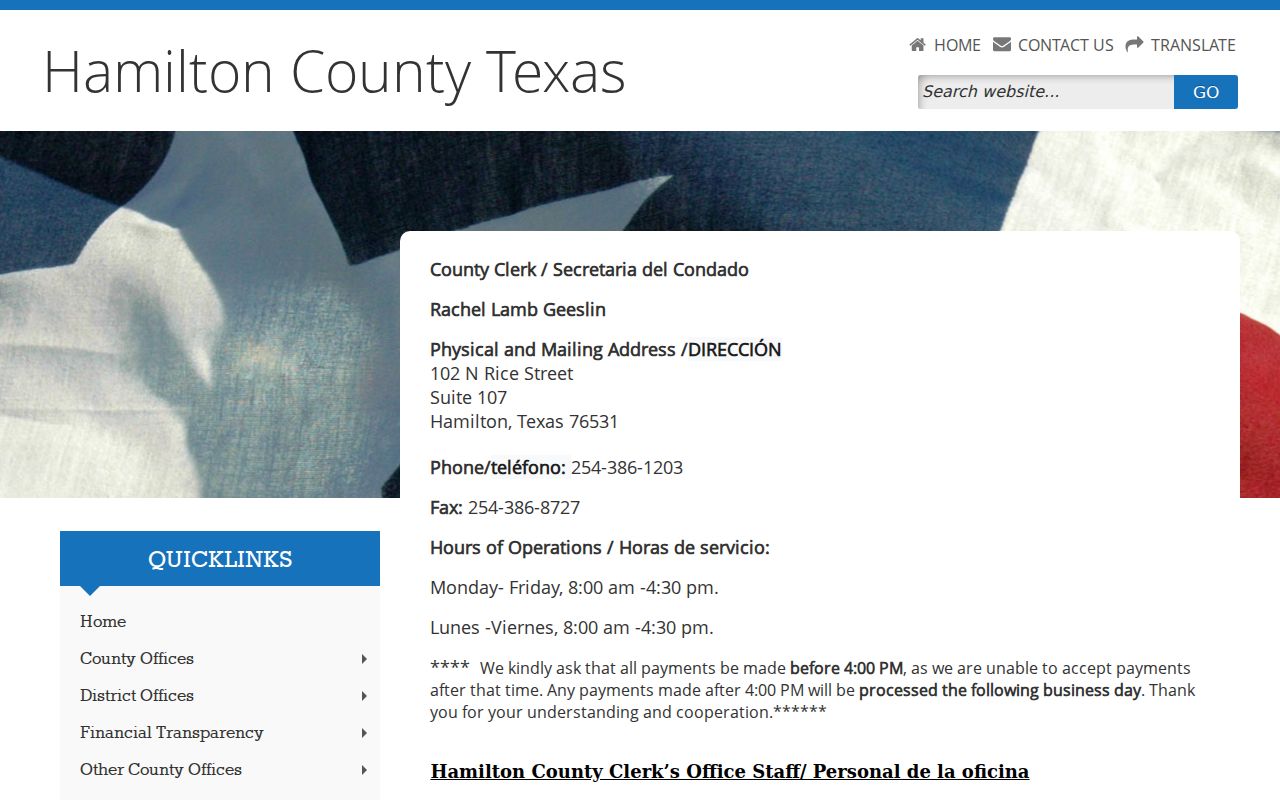
The page helps direct a search to the right clerk, but a posted docket is only a schedule and does not prove guilt or show the final result.
Hamilton County Case Record Searches
Begin with the local Tyler UCM public portal for Hamilton County Court criminal cases, then use the District Clerk directly for felony files. The County Clerk's official wording does not guarantee that the portal covers district felonies. A cause number is the best key. If it is unknown, provide the full name, an estimated filing year, offense level, and any known court. Name-only results need care because people can share or change names.
- Open the Tyler UCM portal and select Hamilton County before entering search terms.
- Use the cause number when available. Otherwise search the party name and narrow by filing year or case type.
- Open the docket, confirm the court and filed charge, and read events in date order.
- Call the District Clerk for felonies or the County Clerk for Class A and B misdemeanors when the record is absent or unclear.
- Submit a written request and pay the stated copy or certification fees when an official document is required.
The portal is deployment-dependent, so available labels may vary. These are the practical search controls documented for the local system.
| Field Label | Type | Required | Notes |
|---|---|---|---|
| County / Location | Dropdown | Yes | Select Hamilton County before relying on results |
| Search type | Tabs or control | Yes | Smart Search, party, or case number where enabled |
| Search | Text | Yes | Enter a name or case number in the shown format |
| Case category / type | Dropdown or filter | No | Choose Criminal where offered |
| Date filed from / to | Date fields | No | Narrows broad name results |
| Search / Submit | Button | Not applicable | Runs the query |
| Clear / Reset | Button | Not applicable | Removes criteria where displayed |
Tyler UCM Hamilton Case Searches
The County Clerk links the Tyler UCM public portal as Hamilton County's online criminal search channel. Select the county first. Then confirm that the result belongs to the right court and person before relying on it. A docket entry may be brief, and some pleadings or exhibits may require a direct clerk request. Portal coverage does not erase the court-level split.
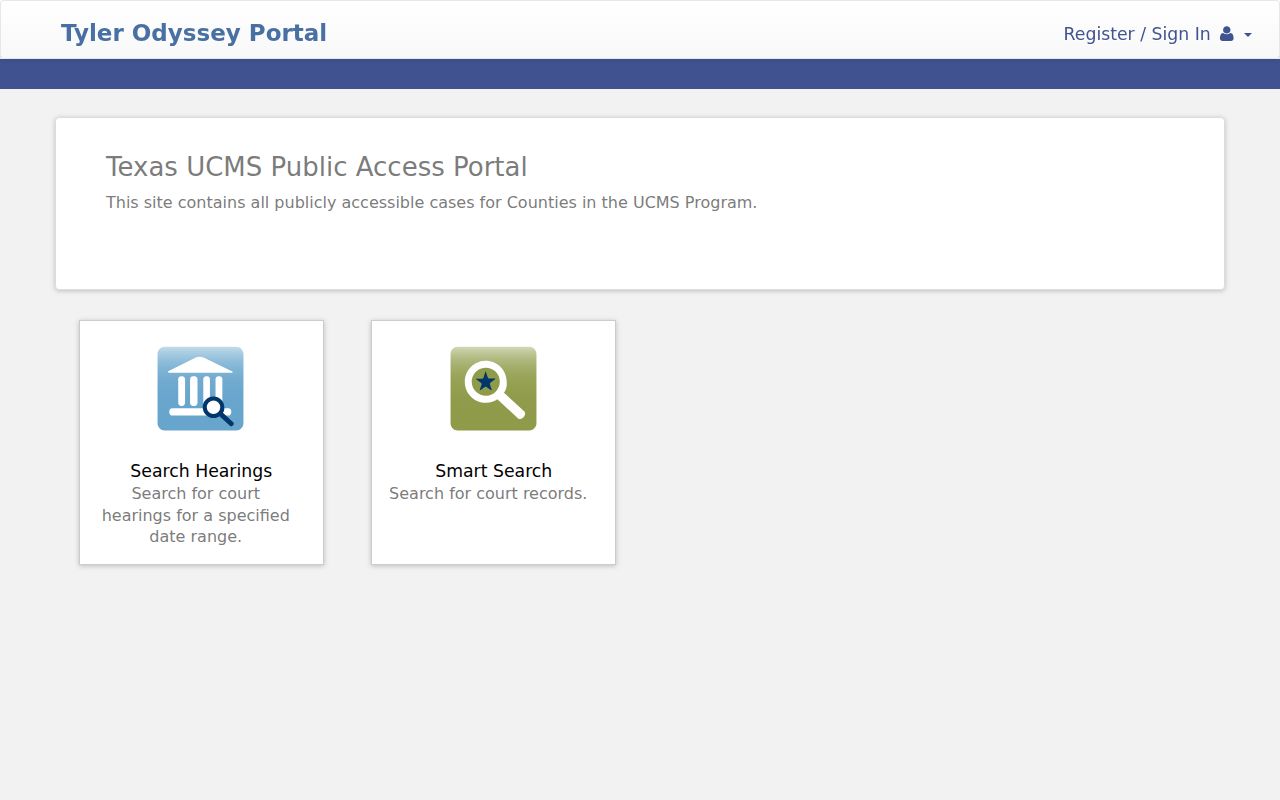
The captured search screen shows why location and case identifiers matter: the portal is a route into local files, not a single statewide criminal database.
If a person is found in a posted criminal docket but no final disposition appears, contact the listed clerk. Settings can move, pleas can change, and a scheduled hearing does not tell how the case ended. The official judgment or certified disposition supplies that answer.
What a Criminal Case File Contains
A Hamilton County criminal case file records the action the prosecutor filed and the court took. It should not be read as a copy of the jail file. The most useful fields connect identity, charge, court events, and outcome. When DPS history appears incomplete, a certified disposition from the clerk is often the key document needed to show the final result.
| Cause Number and Court | Identifies the case and the Hamilton County court with custody of the record. |
|---|---|
| Charging Document | Shows the charge actually filed, which can differ from the arrest allegation. |
| Docket Entries | Lists hearings, filings, counsel appearances, motions, and orders by date. |
| Hearing Dates | Shows scheduled settings, resets, and completed appearances without proving an outcome by itself. |
| Disposition and Judgment | States dismissal, acquittal, plea, conviction, or other final court action. |
| Sentence and Conditions | May list a fine, confinement, community supervision, court costs, and other ordered terms. |
Identity fields can include a legal name, aliases, date of birth, SID, FBI number, or tracking number, but public copies may redact protected details. Never infer identity from the name alone.
Hamilton Criminal Dockets Are Not Judgments
The County Clerk posts 2026 criminal dockets. These lists show that a matter was set for court at the time the docket was prepared. They do not show that a person was convicted, that the setting occurred as planned, or that the listed charge became the judgment. A reset, dismissal, plea change, or later order can alter the path. Use the docket to capture the cause number and court, then obtain the latest event history.
This distinction matters when reconstructing a Hamilton County court case. The filed charge may differ from the arrest charge, and the final disposition may differ again. A docket snapshot belongs in a timeline, not in the conclusion. For an official outcome, ask for the judgment or certified disposition and check its date.
Note: A scheduled Hamilton County court setting is procedural evidence, not proof that the allegation was true or the charge survived.
Criminal Case Stages in Hamilton County
Once a prosecutor files a Hamilton County criminal case, the clerk opens the cause and records each step. Arraignment identifies the charge and plea. Pretrial work can include discovery, motions, negotiations, and settings. A plea or trial leads toward a disposition. If the result includes guilt or deferred adjudication, the court records the sentence or supervision terms. Not every case passes through a trial, and some cases end before sentencing.
Case flow: Charges Filed › Arraignment › Pretrial › Plea or Trial › Disposition › Sentencing
Later events may include an amended judgment, supervision action, appeal, nondisclosure order, or expunction proceeding. Those do not change what the earlier docket meant at the time, but they may change what remains public. Reading the file in order prevents a later order from being mistaken for the original charge.
Hamilton Clerk Fees for Case Records
The Hamilton County District Clerk handles felony record searches and copies. The page below identifies the clerk's local record route.
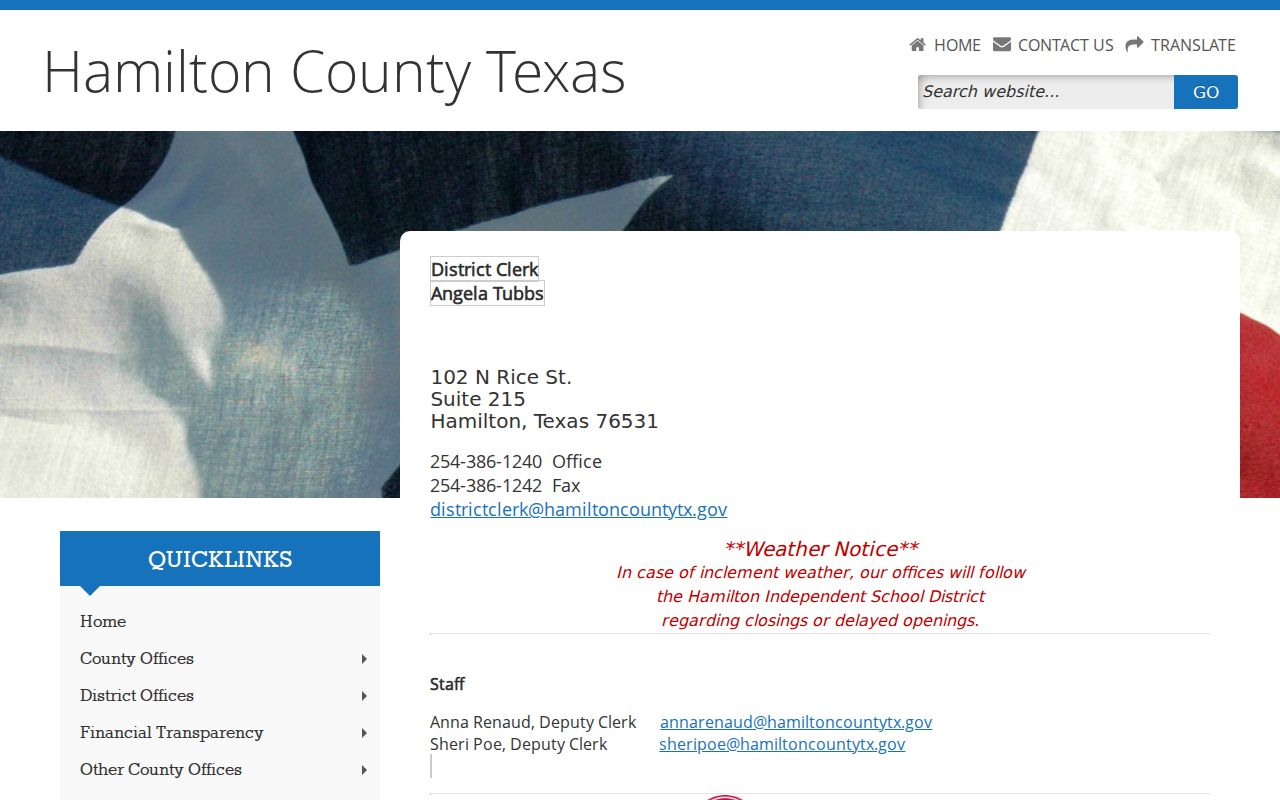
The clerk requires a written request and advance payment, which makes a clear cause number or precise name especially useful.
Without a cause number, the District Clerk lists a $5 name or document search. Copies are $1 per page, certification is $5, and postage is added. Email requests go to districtclerk@hamiltoncountytx.org. Mail goes to 102 North Rice Street, Suite 215, Hamilton, Texas 76531, with a self-addressed stamped envelope and check or money order. Credit-card requests are e-filed after the page count. The form says to allow two business days after the count and payment process.
| District Clerk Item | Stated Amount |
|---|---|
| Name or document search without cause number | $5 |
| Copy | $1 per page |
| Certification | $5 |
| Mail delivery | Postage added |
re:SearchTX Misses Hamilton Criminal Cases
The statewide re:SearchTX portal is not a substitute for the Hamilton County criminal channels. The Texas Judicial Council reports that the statewide public collection includes civil and family records but excludes criminal case records. A blank result there cannot be used to say that no Hamilton County criminal case exists.
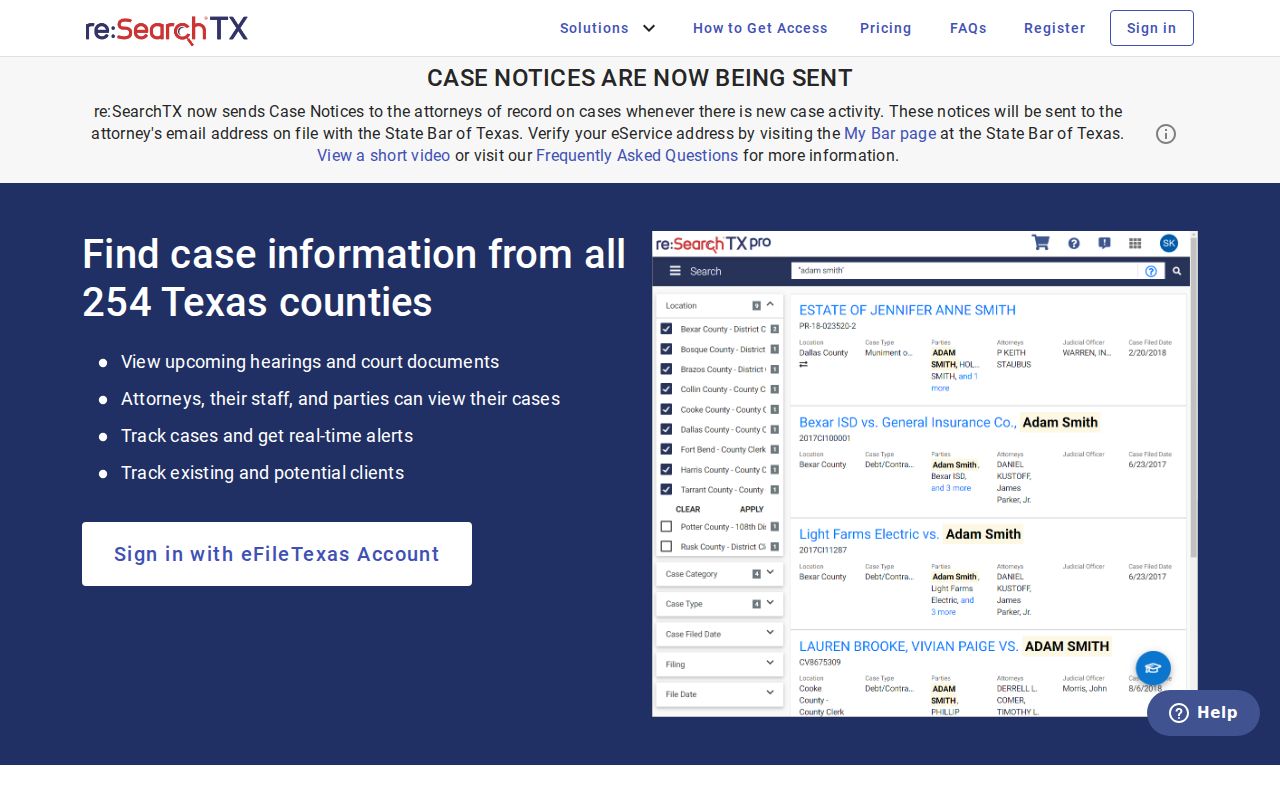
The captured portal is useful context because its broad statewide branding can lead readers to expect criminal coverage that it does not provide.
PACER serves a different layer: federal cases, including filings in the U.S. District Court for the Western District of Texas. It does not hold Hamilton County state prosecutions. The sound fallback is Tyler UCM, the correct local clerk by phone, a written search request, and then in-person inspection if the needed material is not online.
Access Rules for Case Records
Open judicial files can still contain redactions or sealed material. Juvenile court records are generally restricted under Texas Family Code Section 58.007, and automatic sealing rules appear in Section 58.253. Victim data, medical facts, driver-license information, and other confidential details may also be withheld. An online view can therefore contain less than the clerk's paper file, while a sealed file may not be acknowledged in the same way as an open cause.
Judicial records are governed by court rules and common law rather than routing each request through the Texas Public Information Act. Hamilton County's District Clerk specifically directs case researchers to the records search and copy process. An arresting agency report follows a different public-information route under Government Code Chapter 552. Sending a TPIA letter to the clerk for a judicial file can delay the search.
Check the custodian: Ask the District Clerk about felonies, the County Clerk about Class A and B misdemeanors, and the issuing local court about fine-only cases.