
Hamilton Criminal History Checks
Start with the kind of Hamilton record you need, not a broad name query. The city has no municipal police department. The Hamilton County Sheriff’s Office handles current law-enforcement service inside Hamilton, the Hamilton Municipal Court keeps city Class C matters, and the two county clerks divide misdemeanor and felony files. The Texas Department of Public Safety adds a statewide public conviction and deferred-adjudication search, but it does not replace the local incident narrative or the full court judgment.
- For a recent Hamilton incident, arrest, or welfare check, call the Hamilton County Sheriff or nonemergency dispatch and identify the date, place, and event number if known.
- Ask the sheriff for the incident or arrest report and the jail for current custody or booking facts. No official public Hamilton County jail roster was located.
- Use Hamilton Municipal Court for a citation issued within city limits and Hamilton County Justice Court when the citation carries the county’s blue information sheet.
- Search the County Clerk route for Class A or B misdemeanors and Class C appeals. Contact the District Clerk for felony cases in the 220th District Court.
- Use the DPS Criminal History Conviction Name Search for the public statewide slice, or FAST fingerprints through IdentoGO when reviewing your own identity-confirmed Texas record.
The broad Hamilton County criminal history overview explains those county and state layers in more depth. A city-level search should stay focused on Hamilton’s actual custodian first.
Hamilton’s Small-City Record Route
Hamilton had 2,895 residents in the 2020 Census and serves as the Hamilton County seat. That scale helps explain why direct counters and phone calls matter more than a metro-style records dashboard. The sheriff and jail are south of the square on Rice Street, while the County Clerk and District Clerk work in separate suites at the 1931 courthouse. A searcher can move through only a few offices, but must still choose the right one.
The compact system does not make all Hamilton records identical. The deputy’s report, jail booking, municipal citation, county misdemeanor file, and felony judgment remain separate. Keep the event number and cause number as the matter moves, since those identifiers link the layers far more safely than a common name.
Hamilton Has No City Police
The key local fact is easy to miss: the current City of Hamilton law-enforcement page says Hamilton does not operate a municipal police department. Hamilton County deputies provide police service in city limits and report activity to the City Council. A request addressed to a supposed current Hamilton Police Department can therefore go to the wrong custodian.
For a deputy-investigated incident, use the Hamilton County Sheriff’s Office at 1108 S. Rice Street. The jail and sheriff lines are 254-386-8120 and 254-386-8128; nonemergency dispatch is 254-386-3300. Describe a specific event, such as an offense report, arrest report, booking sheet, dispatch record, crash report, or warrant confirmation. Give the date, approximate time, location, agency case number, and enough names to locate it. A request for every file about one person may require clarification and can produce a larger cost estimate.
Hamilton County Sheriff
1108 S. Rice Street
Hamilton, TX 76531
254-386-8128
Nonemergency: 254-386-3300
Hamilton’s Older Police Form
A legacy Hamilton public-record request form still contains a “Police Dept.” label, a 204 E. Main address, and a $6 accident-report line. That older document conflicts with the current city statement that the municipal police department no longer exists. The newer statement controls the routing decision. Confirm both current custody and any current charge with the sheriff before paying or sending a law-enforcement request through old city details.
The old form remains useful for understanding what Hamilton once asked requesters to supply. It has fields for contact information, delivery choice, a date range, a description of the requested information, and staff cost calculations. Those details also show why a precise request works better than a name alone. Use the City Secretary for current city administrative material, but not as a substitute for the deputy’s investigative file.
Note: A dated city form can describe a once-valid route without proving that the same agency, address, or fee remains current.
Records at the Hamilton Police Department
Hamilton law-enforcement records sit with the county office that serves the city. The sheriff can confirm narrow custody facts by phone and receives written requests for existing reports. The Texas Public Information Act does not demand special legal wording. Still, the office may redact active-investigation details, juvenile information, protected victim facts, driver-license data, medical material, or confidential 911 caller information.
City administrative records take a different route. The Hamilton City Secretary works at 200 E. Main, phone 254-386-8116 ext. 5. Published hours are Monday through Thursday, 7:30 a.m. to 5 p.m., and Friday, 8 a.m. to noon. Council records and other city business belong there. Sheriff incident and arrest reports do not.
The city’s own custodian page shows the right counter for administrative files.
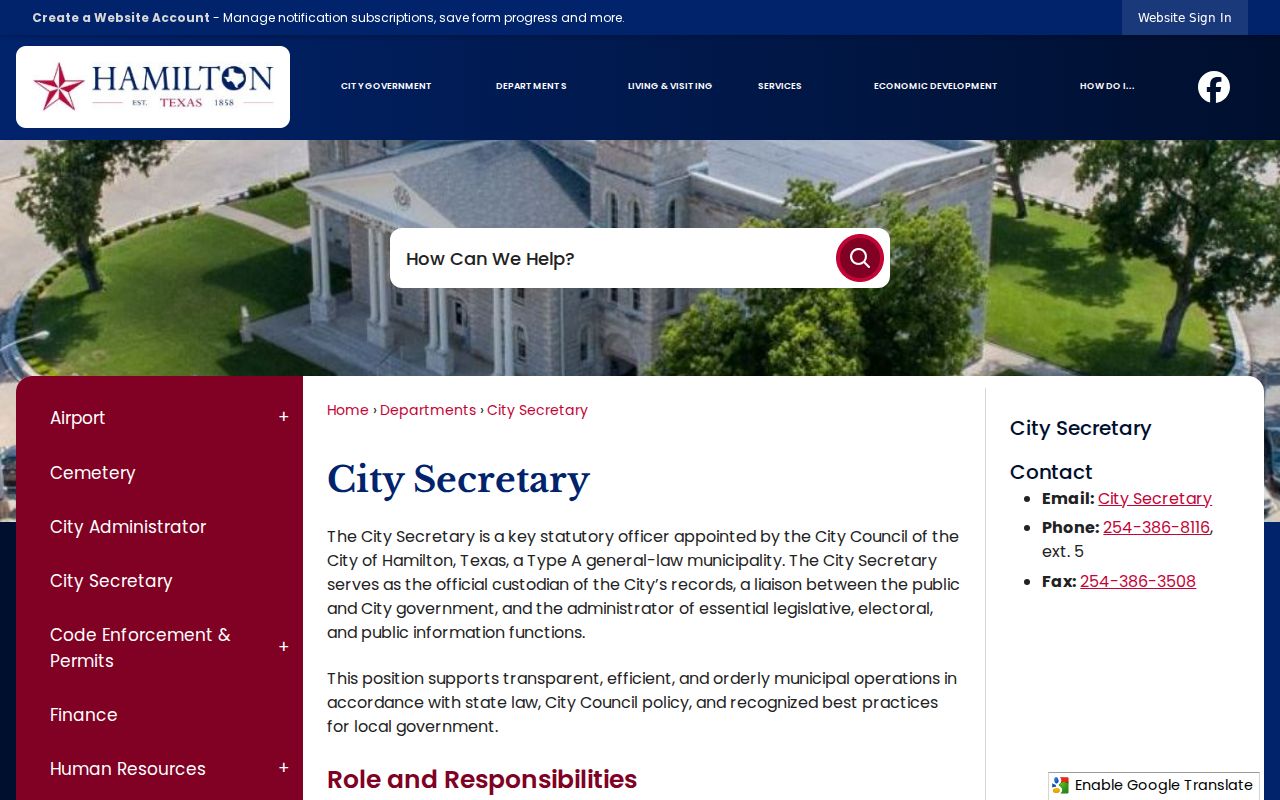
That distinction keeps a Hamilton request from stalling at a city office that did not create the law-enforcement report.
Booking and Arrest Records in Hamilton
A Hamilton arrest can create several files at once. A deputy or DPS trooper writes the incident and arrest narrative. Hamilton County Jail makes the intake record, records the alleged charges and holds, and handles custody data. A prosecutor later decides what to file. The court then creates its own case and disposition. None of these is interchangeable, and the booking allegation is not a finding of guilt.
No official public booking log, jail roster, or Hamilton police blotter was verified. Call the jail for recent custody, then request the report from the agency that made the arrest. For a highway event on U.S. 281 or State Highway 36, the investigating report may belong to DPS even when the person was booked at Hamilton County Jail. The TxDOT CRIS purchase system is the official route for a qualifying peace-officer crash report.
The CRIS interface illustrates that a crash record follows the investigating channel, not merely the city printed in an address.
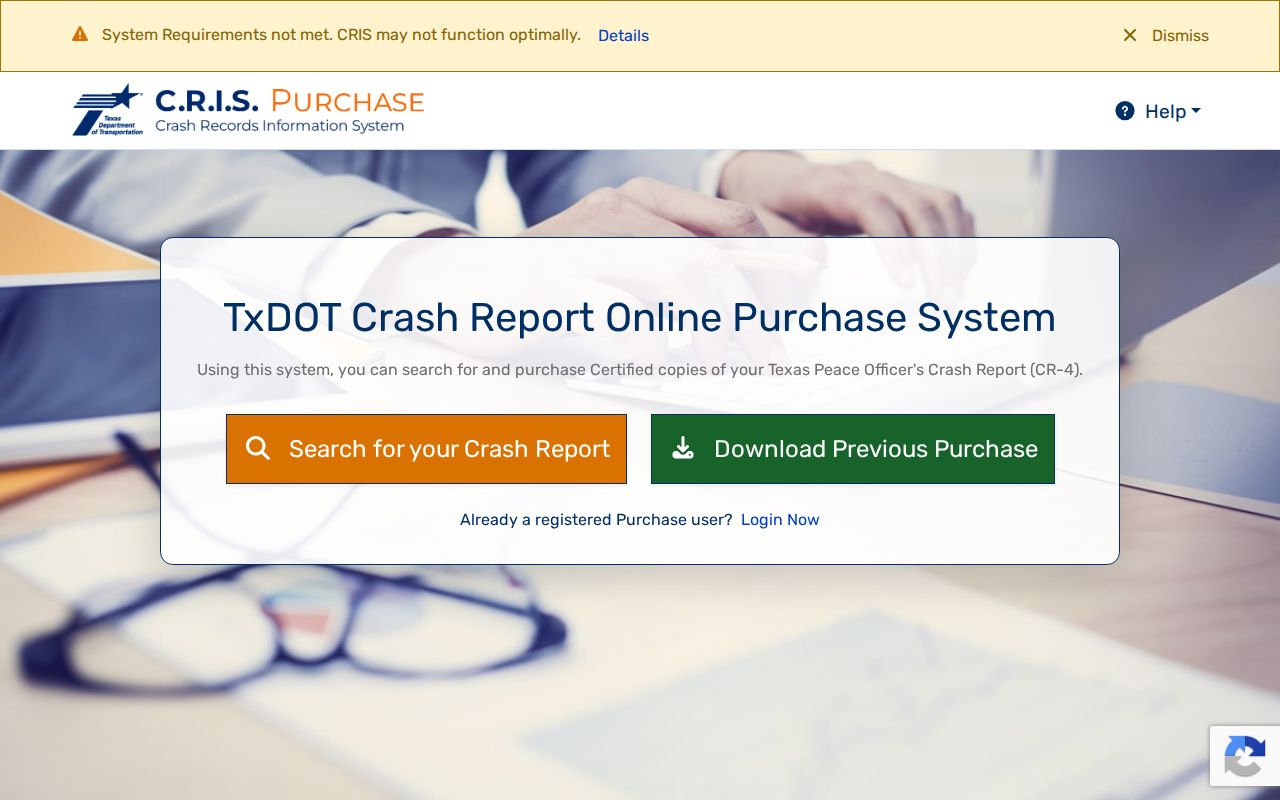
After release, the court file is the better source for the filed charge and outcome. The county Hamilton County arrest search details that custody-to-court handoff.
Hamilton Class C Case Boundary
Hamilton Municipal Court hears fine-only Class C misdemeanors arising inside city limits. These include traffic matters, city ordinance cases, and other fine-only offenses. Court staff can route a citation by phone at 254-386-1221. The municipal judge may conduct hearings and trials, set lawful fines, issue warrants, and provide magistrate warnings. That jurisdiction does not turn the city court into a source for every Hamilton crime.
A citation outside city limits belongs to Hamilton County Justice Court and comes with a blue county information form. If the paperwork is unclear, read the issuing court and citation number before calling. This small step avoids confusing two fine-only courts with different clerks. Online city citation payment can also amount to a guilty or no-contest plea and may cause a conviction to be reported, so confirm the stated effect before submitting payment.
The official Hamilton Municipal Court page is the primary city source for citation routing.
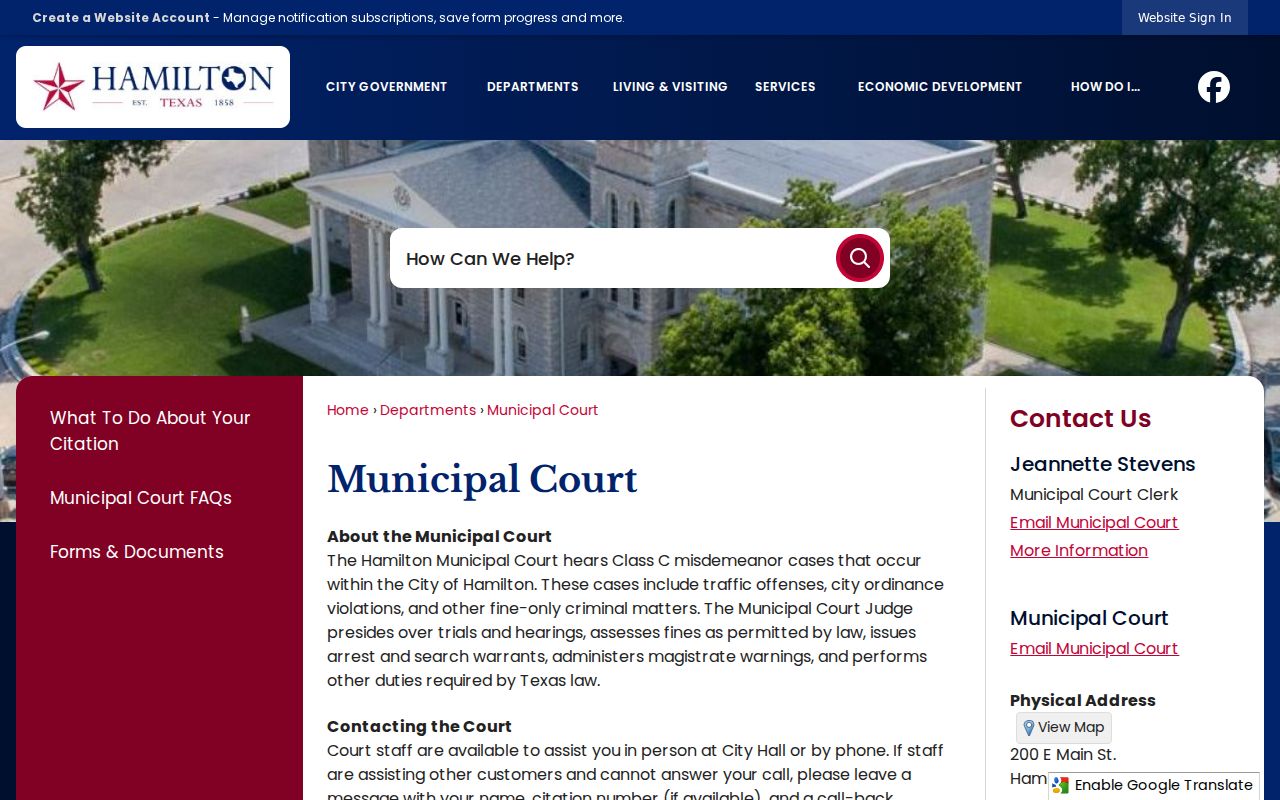
Its city-limit rule is the dividing line between a Hamilton municipal file and a county justice-court file.
The Hamilton Municipal Court File
A city case file centers on the citation and municipal proceedings. Ask by citation number when possible. A posted setting or payment balance does not prove the final disposition, so request the judgment when the outcome matters. Hamilton does not publish a separate anonymous municipal case-search portal in the research, apart from citation payment.
| Court Name | Hamilton Municipal Court |
|---|---|
| Case Types Heard | Traffic, city ordinance, and other fine-only Class C misdemeanor matters arising within Hamilton city limits |
| Case Lookup Channel | Call or visit court staff at City Hall using the citation number; no verified anonymous city docket search was located |
| What the File Shows | Citation, plea, settings, court orders, amounts due, warrant activity where public, judgment, and disposition |
| Copies & Fees | Ask the municipal clerk for the current copy method and charge; no current municipal copy schedule was located |
Class A and B misdemeanors go to the Hamilton County Clerk, while felonies go to the District Clerk for the 220th Judicial District Court. A municipal case can also reach the county level through a Class C appeal.
Wrong Hamilton Court Calls
If the first clerk cannot find a Hamilton case, check the ticket heading and alleged offense level. City-limit Class C matters stay with Municipal Court. Rural Class C cases route to Justice Court. Class A and B misdemeanors belong with the County Clerk in Suite 107, and felonies belong with the District Clerk in Suite 215. A warrant should be confirmed with the issuing court or sheriff instead of inferred from a missing portal entry.
For county misdemeanors, use the Tyler UCM portal linked by the County Clerk and select Hamilton County. For a felony, contact the District Clerk and request the cause file in writing. The published District Clerk form lists $5 per name or document search, $1 per page, $5 for certification, and postage. It asks for advance payment and says to allow two business days after the count and payment process. Those county details are kept brief here because they are not city records.
How Hamilton Records Reach the County
Hamilton’s record flow begins with a county deputy or another responding officer. If custody follows, Hamilton County Jail creates the booking record. The prosecutor may accept, change, or decline the arrest charge. Municipal Court keeps qualifying city Class C cases, the County Clerk maintains filed Class A and B misdemeanors, and the District Clerk holds felony proceedings. Later events are reported to DPS for the Computerized Criminal History system.
Record flow: Hamilton County Sheriff or responding agency › Hamilton County courts › Texas Department of Public Safety
Timing changes what each source can show. The arresting agency has the early narrative. The jail has immediate custody data. The court file shows the filed charge and final result. DPS may lag while agencies send fingerprints and dispositions. A name-only result can also identify a similar person, so compare date of birth and other lawful identifiers. Use FAST fingerprints through IdentoGO to review your own identity-confirmed record.
Hamilton City and Sheriff Records
City administrative records and sheriff records answer different questions. The City Secretary can locate records created by Hamilton’s municipal government. The sheriff holds deputy-created incident and arrest material. Municipal Court keeps fine-only city case files. Asking one office for all three sets invites delay because no single Hamilton custodian owns them.
| Hamilton source | Best request | Not its role |
|---|---|---|
| City Secretary | City administrative and council records | Current deputy incident reports |
| County Sheriff | Deputy reports, booking facts, custody, and warrant confirmation | Municipal judgments |
| Municipal Court | City-limit Class C citations, pleas, and judgments | Felony or Class A/B files |
That source-first method is more reliable than treating “Hamilton criminal records” as one database. It also makes a written request narrow enough for staff to search.
Hamilton Record Access Rules
Texas law generally gives the public access to existing government information, but it does not make every part of a Hamilton police or court file public. A governmental body may seek to withhold active-investigation material, and other laws protect juvenile records, private victim details, medical facts, driver-license information, and certain 911 data. Judicial case records use court rules and clerk procedures rather than an ordinary city TPIA request.
Key Statutes:
Texas Public Information Act, Government Code Chapter 552 gives access to public information, permits lawful charges, and provides exceptions and a ruling process.
Government Code Chapter 411 governs public criminal-history dissemination and orders of nondisclosure.
Family Code Chapter 58 restricts access to juvenile justice records and governs sealing.
The Attorney General’s ten-business-day framework is not a promise that a large request will be produced in ten days. It generally marks the time for release or a request for a ruling. Ask for existing, described records and keep the office’s written reply.